 natbox
Blog / Abuse report
Keeping natbox clean: our first abuse and fraud report
15 November 2026 · Update · By Mohammad AlSaraf
A cheap server with a free trial attracts people who want free compute for things other people pay the price for: spam, attacks, proxy farms. If a provider doesn't stop them, its IP addresses end up on blocklists and every honest customer suffers. So here is what we saw from our launch on 29 October to the morning of 9 November 2026, in numbers. No names, no customer data: only totals.
Sign-ups
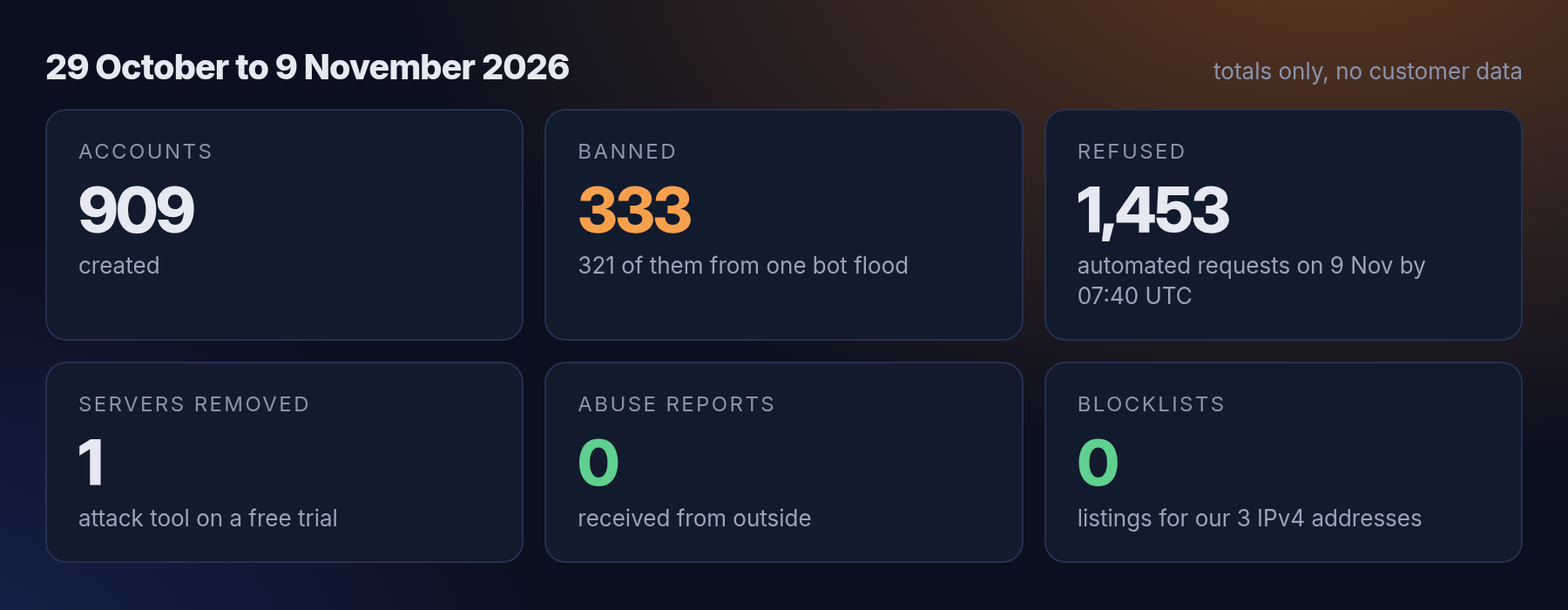
909 accounts were created in our first twelve days. We banned 333 of them:
- 321 in one bot flood. On the night of 8 November a script created about 320 accounts in an hour, several per second, with generated names and sequential addresses, almost all from cloud servers and Tor. None of them got a server. Within an hour we raised the difficulty of our own captcha, limited sign-ups from proxy and Tor networks (home connections and Cloudflare WARP are not affected), and banned the accounts.
- 7 trial-farming accounts: one person with several accounts, or a script logging in every ten minutes to grab a free trial slot the moment it opened.
- 3 accounts of one person who sent around 150 crafted requests to our checkout trying to get something for free. They got nothing.
- 1 account that ran an attack tool on its free trial (more below), and 1 suspended for signing up with an inbox built for AI agents.
Banned accounts are kept, not deleted, so the same addresses can't simply sign up again. Throwaway email services are refused at sign-up, and so are variations of an existing Gmail address.
Free trials
92 free trials were started. Each new trial is checked against earlier ones: our system flagged 21 that shared an IP address with an earlier trial. Most were harmless (shared Wi-Fi, mobile networks, popular VPNs). After looking at each one, we cancelled one second trial taken by the same person and put the slot back for someone else. Two addresses that reloaded the trial page dozens of times an hour with scripts were blocked automatically.
Scripts and bots
Our client area refuses requests from command-line tools and scraping scripts. On 9 November alone, by 07:40 UTC, that was 1,453 requests from 347 addresses. Real browsers, payment notifications and our own monitoring are not affected.
Customer servers
We never look inside a server without a reason (our privacy policy promises that). We watch from outside: CPU, memory, traffic volume and the shape of outgoing connections. In our first twelve days that found three cases:
- An attack tool on a free trial. The server was shut down and deleted, and the account banned.
- Bandwidth-sharing ("proxyware") apps downloaded on a paid server. They never ran. We added a clear ban to our acceptable use policy and asked the customer politely not to start them.
- A server at full CPU around the clock, which our policy doesn't allow on shared plans. We capped it and asked the customer about it.
Every customer server has outgoing mail ports (25, 465 and 587) blocked, so none of them can send spam directly. In our checks we found no mining, no proxyware running, no scanning and no mail sending.
What the rest of the internet sees
- 0 abuse reports from outside. Our abuse form has only ever received our own tests.
- 0 blocklist listings: our three IPv4 addresses are checked regularly against common spam blocklists and are on none of them.
We'll publish numbers like these regularly. If you ever see abuse coming from a natbox address, please report it; we look at every report.
Get new tutorials in Telegram. Follow @natboxio: every new post, plus short server tips.
More from the blog: How much do natbox servers really use?, Why some servers booted without SSH, and how we fixed it, We made disk writes on natbox over 100 times faster. Here's the trade-off. RSS feed.